Showing posts with label genetics. Show all posts

Thursday, September 22, 2022

Who We Are and How We Got Here: Ancient DNA and the New Science of the Human Past, by David Reich (author), John Lescault (narrator)

Blackstone Publishing, ISBN 9781982541286, June 2018

This is the least satisfying of the books I've read/listened to about genetics and the history of human evolution.

In many ways it's excellent. Reich is voracious in absorbing and telling us about other people's research as well as his own. His ego isn't tied up in his own theories; he's enthusiastic in reporting on research results that overturn his own theories and prior work. In many ways, it's both informative and enjoyable.

And yet. Reich seems utterly unaware that he has any biases. He says he's arguing against racism, being very clear that our traditional ideas about race just have no basis in science. Then he goes on to say that the best way to study human genetics is by large population groups, and that some large modern population groups have been separated long enough for significant differences of cognition and temperament to exist.

Sunday, June 12, 2022

God's Science: Biology, Genetics, and Theology, by Paul Scherz (author, narrator)

Now You Know Media, ISBN 9781632515414, February 2018

Paul Scherz has a Ph.D. in genetics from Harvard University, and a Ph,D, in theology from Notre Dame, and is an associate professor of moral theology at Catholic University of America. He's qualified to talk about the relationship between science and religion, and especially biology and genetics, and religion. He does so, as is probably obvious, from a Catholic perspective.

This set of lectures, just under five hours in total, is a very clear, understandable, and for me enjoyable listen.

Monday, March 7, 2022

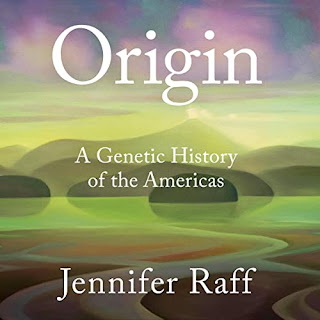
Origin: A Genetic History of the Americas, by Jennifer Raff (author, narrator), Tanis Parenteau (narrator)

Twelve Books, ISBN 9781549148385, February 2022

The peopling of the Americas, the arrival here of anatomically modern humans, and their development  into the peoples I was originally taught to call American Indians and a little later Native Americans, is far more complicated than I was taught in school. It's pretty clear at this point that humans didn't first arrive here a mere ten to twelve thousand years ago. It also appears clear, based on genetic evidence, that they arrived in more than one wave.

And beyond that, it's really, really complicated. The reasons for the complexities are partly the fact that it's very difficult to recover ancient DNA, especially from bones that were buried in warm, wet environments. We also don't have a lot of tools much older than 12 to 15 thousand years ago that are clearly human-made tools. Some, but not enormous numbers.

Thursday, July 22, 2021

A Brief History of Everyone Who Ever Lived: The Stories in Our Genes, by Adam Rutherford (author, narrator)

Tantor Audio, September 2018

Adam Rutherford gives us a fascinating tour of what genetics tells us about the history of our species, including the close relatives with whom we interbred, the Neanderthals and Denisovans.

New discoveries show the first H. Sapiens left Africa even earlier than we previously thought, and didn't always take the paths we assumed. Our DNA tells us a great deal about ourselves as a species, but not nearly as much as we like to imagine about ourselves. There just isn't that much diversity in the genome of H. Sapiens, and most of what there is, is among the peoples of Africa. The rest of us haven't been gone from Africa long enough, or separated from each other long enough, to produce that much genetic variation.

Monday, May 15, 2017

How to Tame a Fox (and Build a Dog): How the Silver Fox Became a Dog, by Lee Alan Dugatkin & Lyudmila Trut

University of Chicago Press, ISBN 9780226444185, March 2017 (original publication January 2016)

In the 1950s, a Russian biologist named Dmitry Belyaev began a dangerous  experiment in fox domestication. It was dangerous not because of the foxes, but because of the primacy in Russian science of Trofim Lysenko, an agronomist who rejected Mendelian genetics. Belyaev and his partner, Lyudmila Trut, persisted anyway, working with Russian commercial silver fox farms. Initially, they presented their work as an effort to increase the productivity of the fox farms. Many domesticated animals can breed more that once a year, and this could be a great boost to productivity.

But in time, as Lysenko's grip on Soviet science faded, and as the first generations of their fox work began to show results, they were slowly able to come out of the shadow. Belyaev became director of the Institute of Cytology & Genetics, while Trut directly headed the silver fox project. She selected the calmest foxes, bred them and selected the calmest of the pups, and in just a few generations, they had calm, friendly, even affectionate foxes.

Monday, February 3, 2014

The Future of the Mind:The Scientific Quest to Understand, Enhance, and Empower the Mind, by Michio Kaku

Doubleday Books, ISBN 9780385530835, February 2014

Michio Kaku, a theoretical physicist with a love of science fiction and of explaining science to non-scientists as well as of physics, once again takes a big, broad subject area that people are fascinated by, and  explores what we know and  can do now, what we can expect in the near future, and what the next century or two might bring us.

This is a readable, fascinating introduction to what we know about the workings of the human brain, and how the mind emerges from it, as well as the current state and realistic prospects for artificial intelligence.

Saturday, May 18, 2013

The Neptune Project, by Polly Holyoke

Disney Book Group, ISBN 9781423157564, May 2013

Global warming has continued to do its worst. Earth is hotter; the seas have risen; climate zones have moved; there has not been the wonderful increase in arable land envisioned by some optimists. As a result, political upheaval has produced new, fragmented, and from what we see, mostly repressive governments.

Nere Hanson is a teenage girl living in the Western Collective, somewhere along what was the southern California coastline. She remembers a happier family past when her father and mother were both marine scientists, and her older brother was still with them. Now, her father is dead, her brother has run off after a steady deterioration of his relationship with their mother, and Nere herself, with weak eyes and weak lungs, is not happy anywhere but in the ocean, with the dolphins her mother still works with. It's a tough life, but it is a life.

Their dangerous secret is that Nere and her mother, Gillian, are both telepaths.

Thursday, October 20, 2011

Thoughts on the Tufts Canine & Feline Breeding & Genetics Conference

Photo by Rachel Doyle
I attended this year's Tufts cat & dog genetics conference at the Omni Parker House in Boston. It was a last-minute opportunity, when my friend Gina Spadafori had to cancel and transferred her registration to me.

It was two solid days, 8am to 5pm, with a lunch break and two short breaks, one in the morning and the other in the afternoon. We sat in a room set up classroom style and listened to researchers and veterinarians talk about genetics research on cats and dogs, and the implications for breeding purebred and pedigreed dogs and cats, as well as behavior and health care for pet dogs and cats. Does that sound dull? It was fascinating!