Showing posts with label non-fiction. Show all posts

Wednesday, October 9, 2024

The First Fossil Hunters: Paleontology in Greek and Roman Times, by Adrienne Mayor (author), Donna Postel (narrator)

Tantor Media, ISBN 9781705276761, February 2021 (original publication April 2000)

I'm not sure it should really surprise me, but the Greeks, Romans, and other ancient cultures did a fair amount of paleontology.

Now, they didn't have our dating techniques, so while they had a good sense that Earth was old, and that the bones they found were from creatures that existed before us and were now gone, they had no idea how old, and didn't necessarily have a good sense of what came before what.

They also couldn't reliably tell what bones belonged with which other bones in the more jumbled and confused fossil sites. Earthquakes exposed a lot of fossils, but also jumbled them together.

Saturday, August 19, 2023

How to Resist Amazon and Why: The Fight for Local Economies, Data Privacy, Fair Labor, Independent Bookstores, and a People-Powered Future! Danny Caine (author, narrator)

Pear Press, ISBN 9781732380394, April 2021

Danny Caine runs an independent, employee-owned bookstore, Raven Book Store, in Lawrence, Kansas. He's also an active small business advocate, and makes an excellent case that Amazon is destructive of small businesses, local economies, and fair business regulation and practices.

Some of the stories in here are funny and delightful; others are horrifying.

Saturday, May 6, 2023

Downward Sizing Dog: A Reformed Big Dog Snob Defends the Small Dog Life, by Karen Lena Izzo

Small Dog Press, LLC, January 2023

Karen Lena Izzo gives the reader a practical, honest, realistic account of her transition from a lover of big dogs, mostly hunting breed dogs, which really negative views of small dogs (with all the insulting views anyone with small dogs has heard ad nauseum), to someone who not only loves her two Havanese dogs, but happily and knowledgeably explains the advantages of small dogs.

First, of course, it's necessary to establish that small dogs are actually dogs, real dogs, with all the traits of dogs, not a failed attempt at a cat. (Whose own advantages, let me point out, not only many big dog owners, but Ms. Izzo, seem not to appreciate.) Small dogs, like big dogs, are people-oriented, loyal, ready to please if you take the time to show them how. They're resilient and adaptable.

Monday, March 27, 2023

Reality Is Not What It Seems: The Journey to Quantum Gravity, by Carlo Rovelli (author), Simon Carnell (translator), Erica Segre (translator), Roy McMillian (narrator)

Audible Audio, January 2014

Another interesting and well-written book about quantum physics and the nature of the universe.

Rovelli has some good things to say about the importance of science, and reviews the history of physics, starting with Demosthenes first hypothosizing the atom. It's lively and interesting, and including fun details I had previously missed. Then we get to the meat of the matter. What is the universe really made of?

The two main theories of the universe, general relativity and quantum physics. General relativity works very well at the scale of the large, while quantum physics works very well at the scale of the very small. The problem is that they don't work well together. And with black holes and the beginnings of the universe, we really need them to work together.

The most popular theory for making them work together has been string theory. String theory seems to work well, but seems not to have the kind of evidence physicists would like to see. Rovelli is not a supporter of string theory, based on the lack of evidence problem. Here he talks about another theory, loop quantum gravity.

His discussion of it makes it interesting. I freely admit I do not understand the math necessary for physics, but Rovelli makes it conceptually interesting and at least seemingly understandable. He says it has more supporting evidence than string theory, while freely admitting there's plenty of room for that to change.

It's an interesting and enjoyable book.

I have to take the efforts of the translators on faith, of course, but the results are enjoyable to listen to, and the narrator does a good job. 

I bought this audiobook.

Monday, February 27, 2023

Dialect Diversity in America: The Politics of Language Change (Page-Barbour Lectures), by William Labov

University of Virginia Press, ISBN 9780813933276. December 2012

William Labov has spent decades studying dialects of English in America, and what his studies reveal are results contrary to common assumptions about dialect in America.

Among those results is that, contrary to popular assumption, broadcast television and radio, and other mass media, are not causing dialect diversity to decrease. Dialects across large regions are not changing to become more alike, but in some ways more different. This includes Northern Inland, Midland, and Southern dialects. Changes in these dialects have progressed somewhat in step with each other--but not in the direction of becoming more similar. Sound changes have arisen and are still arising that produce misunderstandings between primary speakers of one dialect and another. Thinking of language as a means of communication, it seems unexpected that dialects would move further apart when speakers of those dialects are communicating directly with each other as well as consuming the same national media. Labov looks at what seem to be the causes of this seemingly strange development.

Sunday, February 26, 2023

Laziness Does Not Exist, by Devon Price (author), Em Grosland (narrator)

Simon & Schuster Audio, ISBN 9781797120591, January 2021

Devon Price is a social psychologist with a strong emphasis on the practical--what works for individuals, and the importance of recognizing and respecting self-care and your own values.

In this book, their emphasis is on the importance on not valuing yourself solely on your productivity for others. If you are struggling to make deadlines, always exhausted, and on the edge of burning out, you're probably doing something wrong. And the problem isn't "laziness." It's defining your value by how productive you are for others, while setting your own needs, and often health, aside.

Sunday, February 5, 2023

Spare, by Prince Harry

Random House, January 2023

This is not really an easy book to review. It's controversial for obvious reasons; there's been much public controversy around Harry and Meghan, and those who aren't for them, are sometimes quite vitriolic. Even those who aren't vitriolic tend to treat all criticisms and condemnations of the pair as being true because after all, it's Harry and Meghan, and obviously it's them, not Will & Kate, the officially charming heir and wife, now officially Prince and Princess of Wales. And anything that's bad for Harry, well, he should be used to it because royalty, Will's the heir, Harry's the spare, so obviously if he's unhappy he's just resenting his place in the family. Or Meghan is pushing him to, despite the fact that he was obviously unhappy with both the public role and extreme limitations on what he could do. Not a desire to go out clubbing more; a desire to do things he was actually good at--like being a soldier.

Thursday, December 1, 2022

Miracle at Coney Island: How a Sideshow Doctor Saved Thousands of Babies and Transformed American Medicine, by Claire Prentice (author), Coleen Marlo (narrator)

Brilliance Audio, ISBN 9781536689303, August 2017

For forty years, 1903 to 1943, Martin Couney, the "incubator doctor," both cared for and exhibited premature babies in an incubator facility at Coney Island. He also ran similar facilities at amusement parks and world's fairs around the US and in Mexico, London, Paris, and Brazil.

In the late 19th and early 20th centuries, the medical profession considered it not worthwhile to try to save premature babies. It was assumed that even if they lived, they would always be weak, and not productive. Couney disagreed. He believed, based on an exhibit he may have attended in Berlin, and they one he ran in London, that most of these babies could be saved, with good incubators and good care.

Tuesday, November 22, 2022

Unmasking Autism: Discovering the New Faces of Neurodiversity, by Devon Price

Penguin Random House Audio, ISBN 9780593507353, April 2022

This is an insightful book about about being autistic, masking (bluntly, pretending to be neurotypical as well as one can), the important reasons to stop masking, and the risks and benefits of starting to unmask.

Dr. Devon Price is a social psychologist, a professor at Loyola University, and his work is published in peer-reviewed journals in the field. He's also autistic and transgender, and can fairly be said to have a deep personal understanding of the issues of difference, alienation, isolation, and denial of self that he discusses here, along with a professional, scholarly understanding of them that's surprisingly rare in psychological and psychiatric professionals. Autism has mostly been defined as a medical problem to be solved, by getting autistics to behave like neurotypicals, rather than helping autistics to understand and use our differences, and prompting the neurotypical world to make room for our differences and our strengths.

Saturday, November 19, 2022

Doctor Ice Pick, by Claire Prentice (author), Chanté McCormick (narrator)

Amazon Original Stories, May 2022

Dr. Walter Freeman was a neurologist, and  the man who invented the transorbital lobotomy, performed with surgical picks and a medical hammer.  The picks looked like ice picks.

It's not the equipment used, of course, that makes the procedure horrific.

This is a short audiobook, about two hours, but it packs a punch. Freeman began actively, even aggressively, promoting and performing lobotomies in the 1950s in the overcrowded, underfunded mental hospitals of West Virginia. 

Saturday, November 12, 2022

The Song of the Cell: An Exploration of Medicine and the New Human, by Siddhartha Mukherjee (author), Dennis Boutsikaris (narrator)

Simon & Schuster Audio, ISBN 9781797147093, October 2022

Siddhartha Mukherjee is a cancer physcian and researcher, and gives us a fascinating history  of cell biology and cellurlar medicine. Though cancer is a central interest for him, he clearly makes the case that most of modern medicine, not just cancer research and treatment, is cellular medicine.

Friday, September 23, 2022

A Brief History of Black Holes: And Why Nearly Everything You Know About Them is Wrong, by Becky Smethurst (author, narrator)

Macmillan, September 2022

Becky Smethurst is an astrophysicist with a great love of black holes, and a desire to share her enthusiasm for them with the rest of us.

She tries to cover, concisely but with absorbing detail, everything important about them, starting with the important facts that they're not black, and they're not holes. They're not black because an active black hole has an accretion disk which generates a great deal of light and other radiation. They're not holes, because that absolute darkness inside the accretion disk isn't a void. It's an immensely dense accumulation of matter, usually many, many times the mass of a star--certainly our star. Smethurst compares  black holes to mountains, which I find not personally satisfying, but entirely reasonable.

Tuesday, September 13, 2022

The World Before Us: The New Science Behind Our Human Origins, by Tom Higham (author), John Sackville (narrator )

Yale Press Audio, ISBN 9780300263985, August 2021

Tom Higham gives us a fascinating, absorbing history of our species and our genus. We're the last genus Homo species standing, but 50,000 years ago, we were not alone.

Not so long ago, we thought that 50,000 years ago, there were homo sapiens and homo neanderthalensis, and that Neanderthals died out because Sapiens were smarter and more adaptable, and perhaps more deadly to our cousins than they to us. We met in Europe, and they went extinct.

Then recovery and analysis of ancient DNA advanced dramatically, and we got some major surprises.

Wednesday, August 24, 2022

Lives of Unforgetting: What We Lose in Translation When We Read the Bible, and A Way of Reading the Bible as a Call to Adventure, by Stant Litore

Daniel Fusch, 2019

This is a really interesting and enjoyable book about reading the Bible, what we've lost in translation, and how the message of both the Old and the New Testaments has been altered by both the difficulties of translation between different languages, and different cultures. While Jews still read the Jewish Bible in Hebrew, Christians read it in translation. And while no translation can ever be perfect, in many instances in the Bible, the early translations, made at a time much closer to at least the New Testament, and with more communication between Christians and Jews who were often still part of the same communities, have continued to influence our translations as the meanings attached to critical words and phrases have changed.

One example is the phrase, "woman of virtue." The original, Litore explains, is closer to "woman of valor." "Virtue" is from the Roman word "virtu," which was much closer, thought not exact, to the sense of the original Hebrew.

Saturday, August 13, 2022

Beasts Before Us: The Untold Story of Mammal Origins and Evolution, by Elsa Panciroli (author), Ruth Urquhart (narrator)

Tantor Media Inc., ISBN 9781666142747, September 2021

For a long time, most of us have had the impression mammals first emerged in the late Cretaceous, not long before the asteroid that wiped out the non-avian dinosaurs, 66 million years ago. In reality, as Elsa Panciroli explains here, the line that became mammals, the Synapsida, began their split from reptiles in the late Carboniferous, over 300 million years ago.

Panciroli doesn't just tell us about the mammals, but about women as well as men who did important work in uncovering the fascinating, and longer than we often assume, history of mammals. She also talks about some of the less attractive history of paleontological research, the degree to which racism produced not just imperialistic dismissal of local knowledge and observations, but real crimes. This isn't, however, a politicized history; it's just reporting facts about the history of paleontology that are often ignored.

Friday, August 12, 2022

What to Say Next: Successful Communication in Work, Life, and Love—with Autism Spectrum Disorder, by Sarah Nannery (author), Larry Nannery (author), Kelsey Navarro (narrator)

Simon & Schuster Audio, ISBN 9781797116150, March 2021

Sarah Nannery, as a young professional with autism spectrum disorder, got her first job at a small non-profit, sure she knew what she needed to do to move ahead. Instead, she found she was missing messages and hidden meanings in her coworkers texts, emails, conversations, and actions.

After a particularly confusing and frustrating experience, she started consulting her neurotypical husband Larry. This became a series of consultations mostly via text. Sarah learns more about how neurotypicals think, and how to communicate. Along the way, Larry and Sarah learn more about communicating with each other, and raising, managing, and communicating with their autistic son.

Wednesday, August 3, 2022

Big Data: How the Information Revolution is Transforming our Lives, by Brian Clegg (author), Alex Moorcock (narrator)

Dreamscape Media, ISBN 9781666532036, August 2021

We live in a world of big data, with government, corporations, social media, and all kinds of organizations in possession of vast amounts of quite personal data about us--most of which we've handed over ourselves.

That's just one piece big data, though. The accumulation of enormous amounts of data, and the use of modern, advanced computers to process it, has affected every area of our lives and our world. Not much over two centuries ago, medicine was still largely a matter of trial and error, and medical theories we know to be completely wrong.

Monday, August 1, 2022

Tales from the Ant World, by Edward O. Wilson (author), Jonathan Hogan (narrator)

Recorded Books, ISBN 9781980091714, August 2020

Edward O. Wilson was a highly respected and accomplished myrmecologist, i.e., an expert on ants.

You may not think ants are fascinating, but in this book, narrated by Jonathan Hogan, Wilson geeks out about them with joy. In this short book, he gives us overviews of twenty-five different species of ants. Fire ants and leafcutter ants, the fastest-moving ants and the slowest-moving ants, ants who conduct slave raids to steal juveniles who will emerge into adulthood in the raiders' colony and grow up as part of that colony. Ants who farm and ants who keep "cattle." 

Friday, March 25, 2022

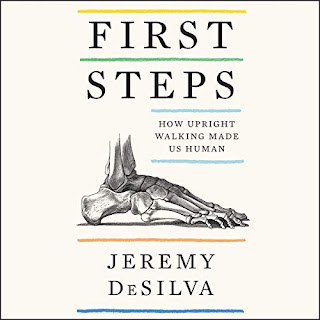
First Steps: How Upright Walking Made Us Human, by Jeremy Desilva (author), Kaleo Griffith (narrator)

HarperAudio, ISBN 9780062938534, April 2021

Jeremy DeSilva gives us a fascinating look at the early evolution of humans, from the, to me, unfamiliar perspective of the human foot and why we walk upright. It's an account that's conversational, clear, empathetic to both early hominins and to fellow researchers, past and present, and careful to present good scientific information, the prevailing understanding of it or his view of it, as well as competing views, with the evidence that supports the competing views. It's fair to say he's not overburdened with ego, and he has a good sense of humor.

Wednesday, March 2, 2022

The Address Book: What Street Addresses Reveal About Identity, Race, Wealth, and Power, by Deirdre Mask (author), Janina Edwards (narrator)

Brilliance Audio, ISBN 9781799751786, April 2020

This is a fascinating examination of the history and development of a mundane fact of everyday life--addresses. We all have addresses; how else would we get our mail or tell people where we live?

Except we don’t all have addresses, and it's not just the homeless who lack them. In large parts of the world, including rural areas of the US, poorer and less privileged areas don't have street names and house numbers. That lack creates problems not just in telling potential visitors where you live, but in getting mail, applying for jobs, registering to vote, and qualifying for aid such as unemployment benefits. Or getting an ambulance to your house in an emergency.