Showing posts with label nonfiction. Show all posts

Sunday, June 19, 2022

Miss Leavitt's Stars: The Untold Story of the Woman Who Discovered How to Measure the Universe (Great Discoveries), by George Johnson (author), Stephen Bowlby (narrator)

Blackstone Publishing, May 2022 

In the early years of the 20th century, a "computer" was a person, an actual flesh and blood human being, who was good at math. These computers were often women, because women were so much cheaper to hire. You could perfectly legally and openly offer much lower wages to women than to men, for the same work.

One of these women was Henrietta Swan Leavitt, employed by the Harvard Observatory to calculate the positions and luminosities of stars in astronomical photographs.

There were two competing theories about the size of the universe at the time. One held that the Milky Way, our galaxy, was the entire universe, and the nebulae seen outside it were just wispy gas clouds. The other held that those nebulae were, in fact, other "island universes"--other galaxies like our own. It was Henrietta Leavitt who did the calculations that made it possible to answer the question. 

Sunday, June 12, 2022

God's Science: Biology, Genetics, and Theology, by Paul Scherz (author, narrator)

Now You Know Media, ISBN 9781632515414, February 2018

Paul Scherz has a Ph.D. in genetics from Harvard University, and a Ph,D, in theology from Notre Dame, and is an associate professor of moral theology at Catholic University of America. He's qualified to talk about the relationship between science and religion, and especially biology and genetics, and religion. He does so, as is probably obvious, from a Catholic perspective.

This set of lectures, just under five hours in total, is a very clear, understandable, and for me enjoyable listen.

Thursday, February 17, 2022

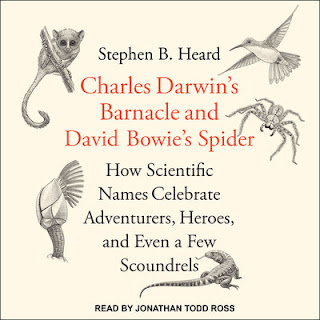
Charles Darwin’s Barnacle and David Bowie’s Spider: How Scientific Names Celebrate Adventurers, Heroes, and Even a Few Scoundrels, by Stephen B. Heard (author), Jonathan Todd Ross (narrator)

Tantor Media, ISBN 9781977300317, March 2020

When Carl Linnaeus invented the binomial naming system, he revolutionized taxonomy, and aside from the purely practical effects, he made possible eponymous naming--naming plants and animals after people. Stephen B. Heard gives us a very lively account of eponymous names, the people they commemorate, and the personalities involved. There are, as the subtitle says, "adventurers, heroes, and even a few scoundrels." It's very entertaining! 

Monday, December 20, 2021

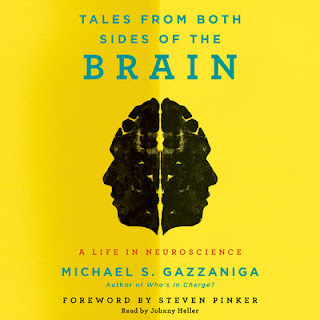
Tales from Both Sides of the Brain: A Life in Neuroscience, by Michael S. Gazzaniga (author), Johnny Heller (narrator)

HarperAudio, ISBN 9780062373410, February 2015

Michael S. Gazzaniga is a leading scientist in the field of cognitive neuroscience, having in fact helped to create the field as the study of the brain advanced. In this book, he discusses his life and his research. He did important, even critical, research on split brains (brains where the corpus callosum, the nerve bundle connecting the left and right sides of the brain) was severed--sometimes in accidents, but often intentionally, in cases where epileptic seizures were unmanageably severe and frequent. It was effective enough to be considered justified in very severe cases--especially as it seemed to have no obvious impact on normal functioning.

Monday, December 13, 2021

How Stella Learned to Talk: The Groundbreaking Story of the World's First Talking Dog, by Christina Hunger

William Morrow, ISBN 9780063046863, May 2021

Christina Hunger was working as a speech pathologist for young children, in Omaha, Nebraska, when she and her boyfriend, Jake, got an eight-week-old Catahoula/Blue Heeler mix puppy. They named her Stella, and started doing what neither of them had done as adults: potty training, walks, crate training, and of course puppy proofing their home.

But as she got to know her new puppy, she noticed behaviors in Stella and in the language-delayed toddlers she worked with. The children and the puppy showed similar pre-linguistic behaviors, the behaviors language-delayed children show before they begin to use words. Christina started to wonder if Stella, exposed to the same language therapy and same type of communication device, could learn to use words to communicate her needs to Christina and Jake.