Showing posts with label climate change. Show all posts

Wednesday, January 10, 2024

Becoming Terran, by Mark Roth-Whitworth

Novus Mundi Books, February 2024

It's 2077, with climate change hitting hard, trillionaires bent on world control, and ordinary people in many places struggling to survive.

A young woman from Niger is working in a hotel in North Africa, when it is seized by one of those trillionaires, Phillippe Tolliver. She catches his attention, and manages to impress him enough that he decides she worth recruiting as his newest personal aide. Renamed Francoise Trouve, she insists on taking her little sister, renamed Amelie, with her.

She takes advantage of all the education he gives her, by AR and intense study, and her sister is tutored until she's sent off to an elite private school in England. They both get genetic engineering to soften their curls and lighten their skin, and Francoise works hard at making herself indispensable to him. First as his aide,and later as a skilled business operative he can send into any of his corporations, both to learn more herself and identify and solve problems, she does.

Tuesday, September 11, 2018

The Coming Storm, by Michael Lewis

Audible Studios, July 2018

The age of Big Data is upon us, and mostly what we hear are the troubling and potentially terrifying consequences of business and government having easy access to all of our data. That's a real problem that we have to devote time and attention to dealing with.

Yet Big Data can do many other things, many of them very beneficial. The misnamed Department of Commerce collects enormous amounts of data about, among other things, the weather. Before the growth of the internet into its modern form, that data mostly sat on paper, and later on tape, and eventually some of it on servers, in the bowels of NOAA--the National Oceanic and Atmospheric Administration, inside the Commerce Dept. Then a grad student with the foresight to see how useful vast stores of data could be went looking for weather data to test out a theory for his research, and stumbled upon a hole in the Commerce Dept. systems that let him download that data and work with it.

Saturday, August 18, 2018

Light of the Stars: Alien Worlds and the Fate of the Earth, by Adam Frank

W.W. Norton & Company, June 2018

What practical use is research into possible extraterrestrial live and civilizations?

We need a new frame to think about our own planet and our relationship. It's just false to all the evidence that we don't affect the habitability of Earth. It's unhelpful, providing no useful path forward, to think of ourselves as a completely malign, destructive force.

We need a new story to tell ourselves, that correctly places us as an active force on Earth, currently doing a lot of damage out of our ignorance until now, but able to change direction and, through use of our growing knowledge, able to make different, more useful decisions.

Thursday, November 24, 2011

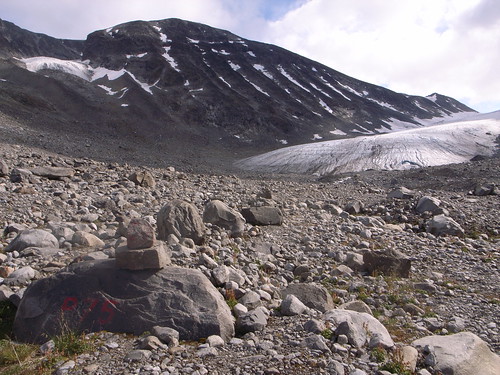
The Fate of Mountain Glaciers in the Anthropocene, A Report by the Working Group Commissioned by the Pontifical Academy of Sciences


Photo credit: Flickr, Iban , Receding Hellstugu glacier

Pontifical Academy of Sciences, April 2011

This is a short report, just seventeen pages, from a body whose existence many did not suspect: the Pontifical Academy of Sciences. The Working Group reviewed the scientific evidence on one particular piece of the global warming problem, the effect on mountain glaciers. Mountain glaciers are important because seasonal melt-off is an important source of water for communities downslope from those glaciers. The short-term effect of increased melting and the retreat of the glaciers from their former extent is more water downstream. The longer-term effect, unfortunately, is the loss of the water sources these communities rely on. The potential for suffering and disruption is high.

Friday, April 16, 2010

Is Mother Nature annoyed with us?

So far this year we've had major earthquakes in Haiti, Chile, Sumatra, Baha California, Spain, the Solomon Islands, and China. That's not a complete list of 6.0 and above earthquakes since January 1.. It isn't even a complete list of the 6.0 and above earthquakes in those places since January 1.

Now, it's worth noting that scientists say this really isn't an unusual level of seismic activity. Six earthquakes of 7.0 or above within the first four months of the year is well within the normal range of variation, apparently. Yet timing, locations, and death toll have been startling and tragic. And the only thing we can do about earthquakes is enforce earthquake-safe building codes in earthquake-prone areas. It's the adoption and enforcement of a sensible earthquake-conscious building code in Chile that helped to make the larger Chile quake less deadly than the Haiti quake.

This week, we have the Iceland volcano. Okay, it's been erupting for a month--but this week, something changed and it started erupting in a different spot, right through icecap, and it's now putting a cloud of volcanic ash into major flight paths all over northern Europe. Scientists can't say how long it will continue to erupt, or how long the eruption will disrupt air travel. Again, this is something we can't control; we can only cope. In this case, that means cancelling air travel for a highly populated area for an unknown period of time. (I should note that what I heard on the news in the last hour suggested that maybe conditions are improving and air travel might start to recover.)

Meanwhile, the ice caps are melting. This March was the warmest March on record. This followed what was, despite the experience of some parts of the US, the fifth-warmest winter on record, worldwide. And that very warming was responsible for some of the American sense of a harsher winter than normal--the melting ice caps means more moisture in the atmosphere, which means storms will produce heavier precipitation, which if those storms happen in areas that are, warmer or not, still below freezing, can result in record-breaking snowfall.

Beyond the obvious yet controversial point that we need to take action to reduce our contributions to global warming if we want to avoid the disastrous effects of some areas becoming much less habitable than they are now while others potentially become more attractive, I have no clear sense of where we go with this. Earth has always been a geologically restless planet; the difference now is that we have both greater means to respond, and greater vulnerability because we depend on high technology and close global interconnections. We need to respect that, and we need to deal with it--intelligently and pragmatically, not ideologically, and not mistake facts we don't like for nefarious political intentions.

We need to start paying attention to what the planet is telling us.