Wednesday, March 24, 2010

The Greater Derry Humane Society

Over the last year, I've become involved with the Greater Derry Humane Society, a Derry, NH rescue group that fosters primarily dogs and cats in private homes while seeking permanent homes for them.
Initially, I was involved only in another activity of GDHS--therapy pet visits to a local nursing home. My dog Addy and I enjoy these visits immensely, and Addy is developing her own little following at the nursing home.
But the main thing is finding homes for homeless animals, and one part of that is getting pictures up on Petfinder so that people looking for pets to adopt can find them. So yesterday, I took pictures of three worthy and deserving cats. Reecie and Angel's profiles are up on Petfinder and their names link to their pages; Domino's should appear soon.
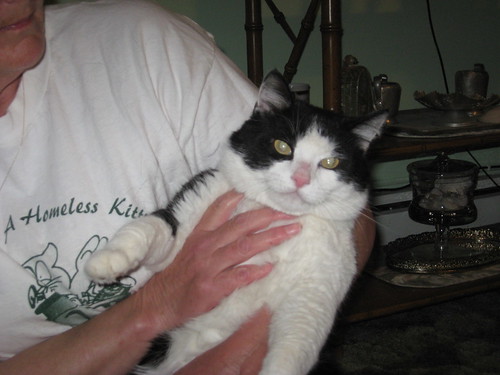
Domino is a big, laid-back, huggable guy.
Domino

Angel is a sweet, beautiful girl.
Angel

Reecie is another good-looking girl who seemed pretty calm despite her doubts about Addy standing beside me while I took the picture.
Reesie

Contact the Greater Derry Humane Society if you're interested in meeting any of these lovely cats.

Thursday, March 11, 2010

USS Constitution Fires Away...

...just as it ought to.

Last November, ironically a few days before Veterans' Day, some apparently new residents of the expensive condos around the Navy Yard in Charlestown complained to the USS Constitution's commanding officer, Timothy Cooper, about the noise of the twice-daily cannon salute accompanying the raising and lowering of the flag. One of the many stories at that time is available here: http://www.thebostonchannel.com/news/21549034/detail.html

It's hard to imagine what the complainers were thinking. Proximity to the USS Constitution was undoubtedly a selling point for this high-priced condo development. The twice-daily firing of the cannons has never been a secret, and is a 200-year-old tradition, not something dreamed up last summer to attract more tourists. If their real estate agents did not disclose this feature of the neighborhood before they purchased, perhaps they have a complaint against those agents--but it would also tell us that they did no research whatsoever about the historic neighborhood they were proposing to move to. Also, this is an urban neighborhood--not a leafy suburb one might move to with a reasonable expectation of peace and quiet.

It's like moving in next to a chicken farm and then complaining about the rooster crowing every morning. Or any small farm, and then complaining about the smell of the manure used to fertilize the fields. Except that in addition to being an unreasonable demand that the neighborhood change to accommodate the newcomers who moved there in part because of the very characteristics they now want changed, this is an attack on an essential piece of American history and a fine patriotic tradition.

Happily, Timothy Cooper has decided that the complainers need not be accommodated. Tradition and history prevail, and the twice-daily ceremony will continue unchanged. Story here: http://www.thebostonchannel.com/news/22808207/detail.html

Tuesday, March 9, 2010

Bella the Future Service Dog

Today, Addy and I visited our nursing home friends as part of our regular pet therapy visits, and as a bonus extra, we met Bella, a future service dog. She's a sweet, five-month-old black Lab, and like any young dog with a demanding career ahead of her, she needs lots of practice meeting all kinds of people, dogs, cats, and anyone and anything else she might encounter in the course of her work.

The girls were a little doubtful of each other at first, but soon teamed up to sit side by side so that they could both get liver treats. No pictures of that because I couldn't take pictures and dispense treats simultaneously!

Service dogs such as Bella will be go everywhere with the person they're teamed with, including places that dogs are normally banned from. Federal law protects their human partners' right to have their canine aides with them, but the flip side is that the dogs must able to behave anywhere, in any circumstances. Puppy raisers like Bella's current foster family raise and socialize the future service dogs so that they're ready for the demanding training they will begin when they reach one year old.
Posted by Picasa

Tuesday, March 2, 2010

E-Books and Libraries

On Friday, Chronicle (on WCVB-TV) focused on ebooks, ereaders, and the future of libraries, in an episode entitled What's the Word. The initial presentation was quite apocalyptic--you can download anything you want to read from the internet, so who needs libraries, right? How can boring old dead tree books compete with the shiny new electronic kind? And if we don't need print books, what use do we have for libraries?

The reality, of course, is rather more complicated, and eventually, so was the Chronicle story. After oohing and aahing over the wonders of the Kindle and the Nook, with very little attention to the problems (for instance, Amazon deleting an edition of Animal Farm that they did not have the rights to, without notifying users, and in the process trashing a high school student's English research paper), eventually they visited several actual libraries, including the new Cambridge library.

And what did they find? Libraries are busy. Circulation is up, participation in library programs is up, and the main obstacle to libraries continuing to grow and expand in services is the inconvenient fact that their budgets are being cut. Partly, of course, because state and municipal budgets are under incredible pressure, but also because of the perception that libraries are "old-fashioned" and not really necessary in this modern age.

But libraries provide something that bookstores, including online bookstores, never can. It's not just a wider range of reading material than any individual can afford to buy. It's not even the fact that all that material is free. What they offer is librarians and their services--knowledgeable guides through both the fiction and non-fiction resources. Someone who's always glad to help you navigate both the print and the electronic resources--whether for recreational reading, or because you want more information on something the doctor said, or because you're looking for a job after twenty years with the same company, and have no idea where to start in making a resume, finding job openings, writing good cover letters.

Online resources offer information. Libraries, and librarians, offer the opportunity to turn that information into knowledge.

Thursday, February 25, 2010

Digital Complications

I’ve been talking with people lately about the implications of the wholesale rush into the online world—a rush I have happily joined, and enjoy immensely both recreationally and professionally, but which is not without its complications and unintended side effects.

Google, of course, is trying to digitize the world and make it all available via their search engine. For Google Books, they've finally reached a deal--sort of--with the publishers, but the only protection offered for the content generators, i.e., the authors, is an opt-out clause, and not all of them are meekly going along:
http://www.wired.com/epicenter/2010/01/le-guin-joins-opposition-to-google-book-search-settlement/

The authors ought to have real control over their works and should not find that by signing a contract agreeing to the print publication of those works they have accidentally signed over electronic rights not mentioned in their contracts without additional compensation, and which potentially impairs the future salability of that work. Yet there are real benefits to the rest of the world in making published material available as widely as possible, and there is no question that online availability aids that. As the publishing world grows more accustomed to our new digital world, I would expect that the standard contract will be rewritten to include those online rights. If they do so without including additional compensation for the authors for that use, however, this will continue to be a battle.

The other interesting development in recent weeks was the showdown between Macmillan and Amazon. Macmillan wanted to restructure the way it sells e-books through Amazon, including raising the price on some books from $9.99 to $14.99. Amazon responded by suspending sale of every single title published by the entire Macmillan publishing conglomerate--not just e-books, but all print books as well:
http://www.boingboing.net/2010/01/29/amazon-and-macmillan.html

Now, Amazon caved after a couple of days and the books reappeared:
http://www.amazon.com/tag/kindle/forum/ref=cm_cd_tfp_ef_tft_tp?_encoding=UTF8&cdForum=Fx1D7SY3BVSESG&cdThread=Tx2MEGQWTNGIMHV&displayType=tagsDetail

But the fact remains that a huge quantity of material simply disappeared from the largest and most familiar source. Amazon was not an exclusive source for the print books, of course, but the same thing has happened with "exclusive" electronic content on subscription online services Lexis and Westlaw that is not published by those companies, as corporate entities negotiate, bid against each other, play hardball, etc. Content that was on one system moves to the other, or becomes temporarily unavailable. Corporations, law firms, and public and academic libraries with large enough budgets to have contracts with both suffer less disruption, though still some loss of efficiency, but the only people who can be sure they have uninterrupted access are those who have the print editions.

Both the Google Books story and the Amazon/Macmillan tussle demonstrate that the customer can all too easily wind up getting the short end of the stick.

F
or all the advantages of electronic access (and they are many), it is concentrating too much control in too few hands, and those hands belong to those whose primary obligation is to the financial health and competitive advantage of their employers, with no professional commitment to the continued and general availability of the content. As a librarian, I find that disturbing. It risks undermining our ability to be an educated, informed society.

Even at its best, electronic access nearly always means you are renting the information rather than buying it. That can be an appropriate choice--but it's important to know that you are doing it, and to make a conscious, thoughtful choice in that regard, and too often it is not.

News from our friends at Two Little Cavaliers

Hard upon my complaint about annoying ads, I'm blogging about a pet-related product review and giveaway over at Two Little Cavaliers. Indiana and Davinia, the two cutest Cavalier King Charles Spaniels in the world, have tried out the Ultra Soft Small Pet Bed by Animal Planet and give it two paws up.

In addition to being incredibly cute, Davinia is also a brave little fighter. Some weeks ago, she was out for a walk with Indiana and their mom, and was attacked and badly injured by two "guard dogs" that got loose from a construction site. Despite major injuries, she has hung in there, kept her sweet temper, and is well on the road to recovery now. Go check out their blog, and admire their cuteness, and Davinia's courage.

Tuesday, February 23, 2010

Annoying Ads

Yes, I know, there are lots of annoying ads. However, there are two ad campaigns in particular that I'm finding especially egregious at the moment.

Toyota Sienna ads

This is the latest entry in that puzzling category, "buy our product so that you can be like these really annoying people you would cross the street to avoid." A husband and wife, who previously imagined themselves too good to drive anything as plebian as a minivan, have bought a Toyota Sienna, which is stylish and wonderful enough to almost equal their own style and wonderfulness. The hubby calls it "The Swagger Wagon." Of course, we all love people who swagger, right? The wife oozes smug satisfaction in having found a minivan that doesn't make her look middle class and married. She also uses the Sienna as a place to just hang out, doing her nails whatever else. When hubby is talking the words appear on the screen over him, "Daddy like." When the wife is talking, the words appear, "Mommy like."

Added bonus: These ads still brag about Toyota reliability. In the midst of a major recall which keeps getting bigger and bigger, when information is emerging that Toyota worked to limit earlier brake-related recalls, and they're still denying that there are any electrical problems despite customer reports.

Volkswagon "Punch Buggy" ads

There's a children's game, dating back to the 1960s, in which the children watch for Volkswagon Beetles, and when they spot one, call out "punch buggy!" or "slug bug!" and punch each other. Volkswagon has inexplicably decided to use a generalized version of the game in their latest ad campaign, with putative adults punching each other at the sight of any Volkswagon, calling out "red one!" or whatever color as they do so. So, okay, why do I want to be anywhere near people acting like that? As with the Toyota Sienna ads, if I'm going to be influenced in my car choice by ads like these, it's not going to be in favor of the cars featured in these ads. If other people's car choices are going to affect mine, I want to drive a vehicle favored by at least minimally rational adults, not by people likely to randomly punch me, or people whose main concern is whether the vehicle supports their egos.

Yes, I do get that these ads are supposed to be funny. The problem is that they are funny if you are somewhere between the ages of six and sixteen--and in most states, you can't even get a driver's license before the age of sixteen. Who do Toyota and Volkswagon think are making the buying decisions?

Saturday, February 20, 2010

Tiger Woods' Apology

Yesterday I watched Tiger Woods' apology and the reaction to it with fascination. Tiger did manage the feat, rare amongst celebrities and politicians, of actually apologizing, saying that he was responsible, that he was wrong, and that his actions had hurt other people. None of your phony, "I'm sorry you're so oversensitive you were offended" non-apology apologies that we hear so often. He talked about his faith (Buddhism) and how adhering to its principles would have kept him from the actions that have landed him in this trouble, and he talked about the sense of entitlement produced by fame, wealth, and celebrity.

He did not talk about the women he had the affairs with, or apologize to them or to their families, who were hurt by this just as his own wife has been hurt. And he did not take any questions.

Tiger has courted media attention for his entire career. He has made millions off of his squeaky clean image, even more than off of the fact that he's possibly the greatest golfer ever. But he has always wanted that media attention to be solely on his own terms. He has always wanted total control of the message. But now we have found out that a large part of that message was a lie--he is not the squeaky clean guy he has been selling to us--and he still wants to control the message.

Let me be clear. Tiger telling the media to back off his wife, his kids, and his mom is totally appropriate. I hope the media listen and heed, though I doubt they will. They are not the ones who made this Faustian bargain.

Tiger is. And Tiger Woods cannot seriously expect that saying "sorry, no questions" will be enough.