336 pp., Houghton Mifflin Harcourt, ISBN 9780547237442, Publication Date January 2011
Forensic archeologist Ruth Galloway is settling back into normal after the unsettling events of a few months ago when she gets a call from the head of the university archeology department. Construction workers on the site of an old house in Norwich that previously served as a children's home have found the bones of a young child. The bones need to be identified, and it needs to be determined as quickly as possible if this is an archeological find or a crime scene. Knowing the police need to be involved, Ruth calls Detective Chief Inspector Harry Nelson, whom she's worked with in the past.
What she hasn't yet told Nelson, who is married and has two teenage daughters, is that she's pregnant as a result of their one night of "We Didn't Get Killed" sex four months ago.
As they piece together the evidence and determine that they have the body of a young girl, they also learn that two children disappeared from the children's home in the early 1970s--and that one of them was a girl about the age of the child whose bones they have. And in the mid-1950s, the young daughter of the family living there at the time, when it was still a private home, also died at the right age--supposedly of scarlet fever.
Meanwhile, another archeologist, Max Gray, working on a site in Swaffham, is showing a friendly and possibly more than friendly interest in Ruth. Ruth is interested, but does she need the complications? Will he still be interested when he knows she's pregnant?
While she's juggling all these problems and complications, alarming things start to happen around Ruth. Someone sacrifices a cockerel and writes her name in blood at the Swaffham site. She hears someone breathing nearby when she's out in the dark, and stumbles and passes out when she sees what appears to be a dead baby--and turns out to to be a model from a museum exhibit.
The tension develops nicely, and the mystery is satisfyingly complex and interesting. This is the second of the series, and some things, such as Ruth's pregnancy and the relationships among some of the characters, are products of the events of the earlier book, The Crossing Places. However, since I have not read it, I can feel completely confident in saying that this book stands on its own sufficiently to be a satisfying, enjoyable read.
Strongly recommended.
Note:: I received a free electronic galley from the publisher via NetGalley
Saturday, November 13, 2010
Tuesday, November 9, 2010
Advent of a Mystery, by Marilyn Leach--Review
256 pp, Barbour Books, September 2010, ISBN 9781602605695
Berdie Elliott is a former investigative reporter, and the wife of the new vicar of Aiden Kirkwood. This is a new calling for Hugh, after a military career, and Berdie has retired from her own career to be the vicar's wife. But she hasn't given up her skills or her active mind, and when an elderly parishioner, Miriam Livingston, is murdered in her home after an evening of caroling and an Advent party at the vicarage, Berdie can't help looking into things. Especially when the village constable is willfully blind to anything but the most obvious evidence, and locks up the most immediately obvious suspect, Jamie Donovan, who quarreled with Miriam Livingston at the party, and whose engraved screwdriver was found near the victim's body and had clearly been used as the murder weapon.
Hugh wants Berdie to stay out of it, to avoid risks both to her own safety and to their still-new status in the village. Both her professional instincts and her sense of justice draw her in, though, and Hugh also can't remain opposed. Too many things don't add up, and Berdie, with her friend Lillie in tow, keeps digging. When they discover that Miriam Livingston is someone other than whom the village has always believed her to be, things start to spiral out of control and the dangers to Berdie that had worried Hugh from the beginning begin to materialize.
This is a really engaging "cozy" mystery, with likable and interesting characters. I hope we'll be seeing more of Berdie and her friends and neighbors.
Recommended.
Berdie Elliott is a former investigative reporter, and the wife of the new vicar of Aiden Kirkwood. This is a new calling for Hugh, after a military career, and Berdie has retired from her own career to be the vicar's wife. But she hasn't given up her skills or her active mind, and when an elderly parishioner, Miriam Livingston, is murdered in her home after an evening of caroling and an Advent party at the vicarage, Berdie can't help looking into things. Especially when the village constable is willfully blind to anything but the most obvious evidence, and locks up the most immediately obvious suspect, Jamie Donovan, who quarreled with Miriam Livingston at the party, and whose engraved screwdriver was found near the victim's body and had clearly been used as the murder weapon.
Hugh wants Berdie to stay out of it, to avoid risks both to her own safety and to their still-new status in the village. Both her professional instincts and her sense of justice draw her in, though, and Hugh also can't remain opposed. Too many things don't add up, and Berdie, with her friend Lillie in tow, keeps digging. When they discover that Miriam Livingston is someone other than whom the village has always believed her to be, things start to spiral out of control and the dangers to Berdie that had worried Hugh from the beginning begin to materialize.
This is a really engaging "cozy" mystery, with likable and interesting characters. I hope we'll be seeing more of Berdie and her friends and neighbors.
Recommended.
Note:: I received a free electronic galley from the publisher via NetGalley
Against the Wind (The Raines of Wind Canyon), by Kat Martin--Review
MIRA Books, January 2011, ISBN 9780778329190
Sarah Allen, finally freed from an abusive marriage by the unsolved murder of her husband, gathers up her young daughter and the few possessions left to her after everything is sold to pay her husband's debts, and returns to her childhood home of Wind Canyon, Wyoming. She's rented a small house on the property of one of the local ranches, and landed a job with the local newspaper,. She'll finally be putting her journalism degree to some use, and as a bonus she'll be living near enough to visit her last surviving relative, her grandmother.
But Sarah's troubles aren't over yet. She's getting calls from a former business associate of her husbands, who is quite certain that Sarah knows where Andrew kept a disk or flash drive with some vital information. And the owner of the ranch she's moved onto is Jackson Raines, whom Sarah yearned for and spurned in high school. Sarah and Jackson resist their mutual attraction while the calls get more threatening--but when the calls progress to the trashing of Sarah's cottage and her grandmother's home, she has no one to turn to but Jackson.
Trouble keeps closing in on them, as the FBI threatens Sarah with charges to force her to give information she doesn't have about Andrew's business activities, and his former associates get more violent in their pursuit of that flash drive. And there's still one secret Sarah is keeping from Jackson, something she knows will kill his growing love for her.
This is a well-written romance with interesting, likable characters, and the added bonus that no one does anything stupid or creates a willfully stupid misunderstanding in order to create necessary plot complications. Sarah's secret reason for pulling back is real and serious, and Jackson reacts like an adult, not an over-reactive teenager. These are solid adult characters, well worth the time spent with them.
Recommended
Sarah Allen, finally freed from an abusive marriage by the unsolved murder of her husband, gathers up her young daughter and the few possessions left to her after everything is sold to pay her husband's debts, and returns to her childhood home of Wind Canyon, Wyoming. She's rented a small house on the property of one of the local ranches, and landed a job with the local newspaper,. She'll finally be putting her journalism degree to some use, and as a bonus she'll be living near enough to visit her last surviving relative, her grandmother.
But Sarah's troubles aren't over yet. She's getting calls from a former business associate of her husbands, who is quite certain that Sarah knows where Andrew kept a disk or flash drive with some vital information. And the owner of the ranch she's moved onto is Jackson Raines, whom Sarah yearned for and spurned in high school. Sarah and Jackson resist their mutual attraction while the calls get more threatening--but when the calls progress to the trashing of Sarah's cottage and her grandmother's home, she has no one to turn to but Jackson.
Trouble keeps closing in on them, as the FBI threatens Sarah with charges to force her to give information she doesn't have about Andrew's business activities, and his former associates get more violent in their pursuit of that flash drive. And there's still one secret Sarah is keeping from Jackson, something she knows will kill his growing love for her.
This is a well-written romance with interesting, likable characters, and the added bonus that no one does anything stupid or creates a willfully stupid misunderstanding in order to create necessary plot complications. Sarah's secret reason for pulling back is real and serious, and Jackson reacts like an adult, not an over-reactive teenager. These are solid adult characters, well worth the time spent with them.
Recommended
Note:: I received a free electronic galley from the publisher via NetGalley
Thursday, November 4, 2010
God Soul Mind Brain: A Neuroscientist's Reflections on the Spirit World, by Michael S. Graziano
156 pp., Leapfrog Press, September 2010, ISBN 9781935248118
Michael Graziano is a professor of neuroscience at Princeton. He freely identifies himself as an atheist, and suggests that he may somewhere on the autism spectrum and that this may affect his view of the world and of people.
Graziano argues that a belief in God is not imaginary, a delusion, or even a "belief" in the usual sense, but rather a perception that grows directly out of the same neural circuitry that allows us to perceive consciousness not only in other people, but in ourselves. We (those of us who are religious) perceive God in the world for the same reasons we perceive consciousness and personality in other people--because evolution has created the machinery in the brain that allows social animals to predict and understand each other's behavior. This is an essential ability for animals in complex social relationships, and like other abilities, likely varies in degree between individuals. Graziano suggests that the ability is somewhat less intense than average in people with some degree of autism, and that it may be stronger than average religious visionaries, those who see ghosts, and others with a higher than average degree of engagement with the "spirit world."
The discussion of the "spirit world," however, is only a part of this book, and although it's the obvious interest, in fact I found the overall discussion of how the mind and consciousness originate in the brain, and key developments in neuroscience related to this, to be every bit as fascinating. This is a short book, and an easy read considering its subject matter. There's an ample bibliography for those interested in further reading, but you won't be tripping over footnotes while zipping through the main text.
Highly recommended if you're at all interested in the subject.
Note:: I received a free electronic galley from the publisher via NetGalley
Thursday, October 28, 2010
Don't Be Such a Scientist: Talking Substance in an Age of Style, by Randy Olson---Review
Island Press, (c)2009, ISBN 1597265632

Randy Olson is a marine biologist who did his research, did his publishing, and became a tenured professor at the University of New Hampshire.
And then he resigned to become a filmmaker.
In Don't Be Such a Scientist, Olson talks about his own journey from scientist to science filmmaker, and explores the problems of communicating science to a broad audience. He finds the problems to lie mainly in a disconnect between how scientists learn to communicate with each other and the kinds of communication that work with the general, non-scientist public, and especially what does and does not work in the mass media.
Scientists place the highest value on accuracy; they correct inaccuracies, they question assumptions, they demand evidence. This is all vital to what scientists do; without these behaviors, real advances in knowledge can't happen. But when scientists use those same behaviors when talking to the general public, and especially when speaking on tv or making films and videos intended to reach the general public, these same behaviors come across as negative, argumentative, and unlikeable. Scientists, Olson says, work almost entirely in their heads, while reaching a broad audience--even getting the attention of a broad audience, due to how inundated we are with information--requires reaching the heart, the gut, and even, as he delicately phrases it, "the lower organs."
To illustrate the impact of an over-emphasis on being serious and relentlessly accurate, vs. presenting the information with style, heart, and even humor, he compares the reception given to two 2006 movies about global warming--HBO's April 2006 Too Hot Not Too Handle, and Al Gore's May 2006 An Inconvenient Truth. The first, he says, was "solid, relatively impersonal, objective effort featuring interviews with many top scientists." The second is a personal narrative by Al Gore, featuring his stories of long-term involvement with the issue, the tragedies involving his sister and his son, some humor, along with lots of substance. With all the emphasis on style, Gore nevertheless used PowerPoint graphs in abundance to communicate facts and data.
The HBO movie was completely accurate--but also boring and depressing. It sunk without a trace. Gore's was filled with important information, but had some inaccuracies that would never have survived in the HBO effort. But none of those errors were important enough to undermine the central point--and An Inconvenient Truth was a huge hit, and won both an Oscar and a Nobel Prize. Which was more effective in getting real knowledge of global warming to the general public?
Some of the entertaining stories Olson has to tell include his own collision with acting class (news flash: scientists are not naturals at just going with their feelings), the struggles to make his own 2006 film on evolution vs. "intelligent design," Flock of Dodos, watchable--and then the reaction of science bloggers to a movie that still wasn't accessible enough for distributors to want it for general audiences.
I'm not doing justice to the book, but it's short, pithy, and completely readable, along with providing ample food for thought on how to communicate science to the general public.
Important note: I received a free electronic galley of this book from the publisher, Island Press.

Randy Olson is a marine biologist who did his research, did his publishing, and became a tenured professor at the University of New Hampshire.
And then he resigned to become a filmmaker.
In Don't Be Such a Scientist, Olson talks about his own journey from scientist to science filmmaker, and explores the problems of communicating science to a broad audience. He finds the problems to lie mainly in a disconnect between how scientists learn to communicate with each other and the kinds of communication that work with the general, non-scientist public, and especially what does and does not work in the mass media.
Scientists place the highest value on accuracy; they correct inaccuracies, they question assumptions, they demand evidence. This is all vital to what scientists do; without these behaviors, real advances in knowledge can't happen. But when scientists use those same behaviors when talking to the general public, and especially when speaking on tv or making films and videos intended to reach the general public, these same behaviors come across as negative, argumentative, and unlikeable. Scientists, Olson says, work almost entirely in their heads, while reaching a broad audience--even getting the attention of a broad audience, due to how inundated we are with information--requires reaching the heart, the gut, and even, as he delicately phrases it, "the lower organs."
To illustrate the impact of an over-emphasis on being serious and relentlessly accurate, vs. presenting the information with style, heart, and even humor, he compares the reception given to two 2006 movies about global warming--HBO's April 2006 Too Hot Not Too Handle, and Al Gore's May 2006 An Inconvenient Truth. The first, he says, was "solid, relatively impersonal, objective effort featuring interviews with many top scientists." The second is a personal narrative by Al Gore, featuring his stories of long-term involvement with the issue, the tragedies involving his sister and his son, some humor, along with lots of substance. With all the emphasis on style, Gore nevertheless used PowerPoint graphs in abundance to communicate facts and data.
The HBO movie was completely accurate--but also boring and depressing. It sunk without a trace. Gore's was filled with important information, but had some inaccuracies that would never have survived in the HBO effort. But none of those errors were important enough to undermine the central point--and An Inconvenient Truth was a huge hit, and won both an Oscar and a Nobel Prize. Which was more effective in getting real knowledge of global warming to the general public?
Some of the entertaining stories Olson has to tell include his own collision with acting class (news flash: scientists are not naturals at just going with their feelings), the struggles to make his own 2006 film on evolution vs. "intelligent design," Flock of Dodos, watchable--and then the reaction of science bloggers to a movie that still wasn't accessible enough for distributors to want it for general audiences.
I'm not doing justice to the book, but it's short, pithy, and completely readable, along with providing ample food for thought on how to communicate science to the general public.
Important note: I received a free electronic galley of this book from the publisher, Island Press.
Labels:
book reviews,
books,
science
Thursday, September 16, 2010
My adventures in ebooks
I've always been a holdout against ebooks. Reading a large amount of text on a computer screen is not appealing, and even a laptop is just not portable enough. It's heavy, you can run down the battery way too soon for a good reading experience if you're not plugged in, etc. PDAs and cellphones are obviously a lot more portable, but really, that's a tiny screen.
As for dedicated ebook readers... One is from Sony. After the rootkit nonsense of a few years ago, I'll never trust a Sony device again. Some of my friends have Kindles, and they love them. I've looked at them, held them--and not loved them. Not hated--just, not loved them. I suspect that if I traveled a lot, and carrying enough reading material on planes and trains were therefore an issue for me, I'd probably have succumbed. But I don't, so I didn't.
Then this summer my mother decided she wanted an ebook reader, or was convinced by my sister that she did, so that she could check books out of the library without having to leave her apartment on the days when she's less than fully mobile. She wanted to go look at ereaders, and asked me to come with her. We wound up at Barnes and Noble, looking at the Nook. Excuse me, the nook. B&N favors the lower-case n for the name of their device.
What can I say? I fell in love. It's the right size. The display is nice, e-ink really is almost like reading a printed page, far better than a typical computer screen display. It's about the weight of a trade paperback, and a bit smaller in dimensions--even with the optional but highly recommended case/cover. The battery life is more than decent, in part because the nook uses power only when changing something (such as turning a page), the touchscreen portion is active, or you're using the wi-fi or 3G capabilities. About once a week, I need to plug it in for a few hours, and the rest of the time, I don't have to worry about it at all.
It's easy to adjust the size of the text to what's comfortable for you, and I do find that on the nook screen I prefer a larger text size than I would like on the printed page. I've also loaded on a few pictures of my dog to serve as my screensaver; it's easy to do, and fun to see her cute face every time I pick it up. Once you've got the book you're reading open, and the control touchscreen at the bottom goes dark, you can turn pages by swiping a finger over the darkened touchscreen. It's about as close to reading a print book as an electronic device can probably achieve.
Of course, if you spend the money on a ebook device, you're not only concerned about ease of use. You're also concerned about availability of material. Overall, ebook prices are closer to paperback prices than to hardcover prices, but that's not universally true. The sad truth is that many publishers are so afraid of piracy that they make ebooks expensive and load them down with DRM (digital rights management) that makes them hard to use conveniently--and of course impossible to lend.
However, I'm finding more than enough that's available at close-to-paperback cost that I don't feel unduly restricted in my reading choices. Barnes & Noble also offers some free ebooks; so does Amazon for the Kindle. B&N, unlike Amazon, does allow "lending" of ebooks bought from them--if the publisher agrees. It's very restricted (only for two weeks, and any given book can only be lent once), but it's a beginning. When the publishers realize that this is not hurting but rather helping their sales, I'm sure it will expand.
You can borrow ebooks from your public library, too (remember, this is where we started, with my mother's desire to do so.) What and how much is available this way will depend on what library or libraries you belong to, and what consortia they belong to, but if you are open in your reading choices, you may find that there's plenty of reading material available.
There are also other sources of free ebooks. At Manybooks.net, there are many older classics and older forgotten-but-excellent books available, out of copyright protection and unburdened by DRM. Some authors offer some of their own books as free or inexpensive ebooks, and some publishers, in contrast to the publishers who are terrified of the digital age, do the same with older titles. If you are a science fiction reader Baen Books is an excellent source of free sf, and you should also check out their ebook store for more current titles, not free of course, but not expensive if they're the books you want.
I'm enjoying my nook, and I think I will continue to do so.
Oh, and my mother? She wound up buying a netbook, instead, which makes sense for her needs. She had no computer at all, and library ebooks need to be downloaded to your computer first and then transferred to your ereader device, so the nook, or the Kindle, or the Sony reader, alone, wouldn't have helped her. She also wanted email access. Her netbook isn't much bigger than the nook, and it does the other things she needs. Less battery life, of course, but since the whole point is that she wanted something that would allow her to not go out when she wasn't feeling up to it, that's not really a issue. She can curl up and read with this, and still keep it plugged in most of the time.
Do I think ebooks are going to replace print books? Not anytime soon, no. They're a nice additional option, though.
As for dedicated ebook readers... One is from Sony. After the rootkit nonsense of a few years ago, I'll never trust a Sony device again. Some of my friends have Kindles, and they love them. I've looked at them, held them--and not loved them. Not hated--just, not loved them. I suspect that if I traveled a lot, and carrying enough reading material on planes and trains were therefore an issue for me, I'd probably have succumbed. But I don't, so I didn't.
Then this summer my mother decided she wanted an ebook reader, or was convinced by my sister that she did, so that she could check books out of the library without having to leave her apartment on the days when she's less than fully mobile. She wanted to go look at ereaders, and asked me to come with her. We wound up at Barnes and Noble, looking at the Nook. Excuse me, the nook. B&N favors the lower-case n for the name of their device.
What can I say? I fell in love. It's the right size. The display is nice, e-ink really is almost like reading a printed page, far better than a typical computer screen display. It's about the weight of a trade paperback, and a bit smaller in dimensions--even with the optional but highly recommended case/cover. The battery life is more than decent, in part because the nook uses power only when changing something (such as turning a page), the touchscreen portion is active, or you're using the wi-fi or 3G capabilities. About once a week, I need to plug it in for a few hours, and the rest of the time, I don't have to worry about it at all.
It's easy to adjust the size of the text to what's comfortable for you, and I do find that on the nook screen I prefer a larger text size than I would like on the printed page. I've also loaded on a few pictures of my dog to serve as my screensaver; it's easy to do, and fun to see her cute face every time I pick it up. Once you've got the book you're reading open, and the control touchscreen at the bottom goes dark, you can turn pages by swiping a finger over the darkened touchscreen. It's about as close to reading a print book as an electronic device can probably achieve.
Of course, if you spend the money on a ebook device, you're not only concerned about ease of use. You're also concerned about availability of material. Overall, ebook prices are closer to paperback prices than to hardcover prices, but that's not universally true. The sad truth is that many publishers are so afraid of piracy that they make ebooks expensive and load them down with DRM (digital rights management) that makes them hard to use conveniently--and of course impossible to lend.
However, I'm finding more than enough that's available at close-to-paperback cost that I don't feel unduly restricted in my reading choices. Barnes & Noble also offers some free ebooks; so does Amazon for the Kindle. B&N, unlike Amazon, does allow "lending" of ebooks bought from them--if the publisher agrees. It's very restricted (only for two weeks, and any given book can only be lent once), but it's a beginning. When the publishers realize that this is not hurting but rather helping their sales, I'm sure it will expand.
You can borrow ebooks from your public library, too (remember, this is where we started, with my mother's desire to do so.) What and how much is available this way will depend on what library or libraries you belong to, and what consortia they belong to, but if you are open in your reading choices, you may find that there's plenty of reading material available.
There are also other sources of free ebooks. At Manybooks.net, there are many older classics and older forgotten-but-excellent books available, out of copyright protection and unburdened by DRM. Some authors offer some of their own books as free or inexpensive ebooks, and some publishers, in contrast to the publishers who are terrified of the digital age, do the same with older titles. If you are a science fiction reader Baen Books is an excellent source of free sf, and you should also check out their ebook store for more current titles, not free of course, but not expensive if they're the books you want.
I'm enjoying my nook, and I think I will continue to do so.
Oh, and my mother? She wound up buying a netbook, instead, which makes sense for her needs. She had no computer at all, and library ebooks need to be downloaded to your computer first and then transferred to your ereader device, so the nook, or the Kindle, or the Sony reader, alone, wouldn't have helped her. She also wanted email access. Her netbook isn't much bigger than the nook, and it does the other things she needs. Less battery life, of course, but since the whole point is that she wanted something that would allow her to not go out when she wasn't feeling up to it, that's not really a issue. She can curl up and read with this, and still keep it plugged in most of the time.
Do I think ebooks are going to replace print books? Not anytime soon, no. They're a nice additional option, though.
Tuesday, August 3, 2010
Pelham Adoption Day 7-24-10
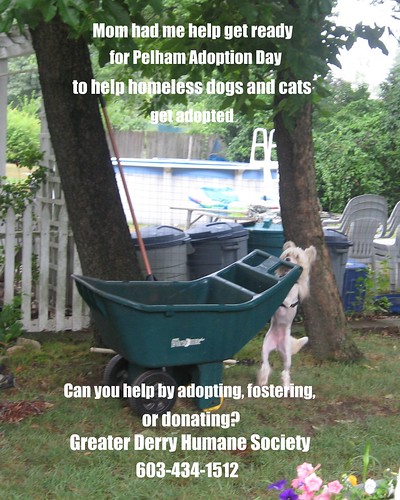
In the morning, Addy landed a starring role in a Greater Derry Humane Society poster:

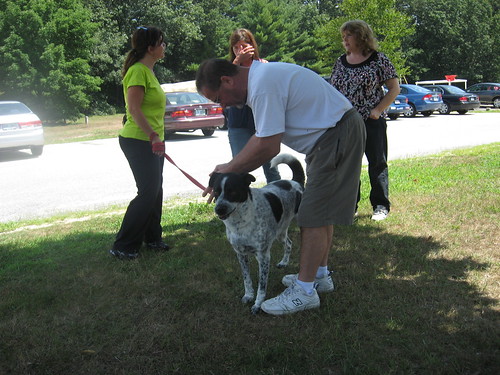
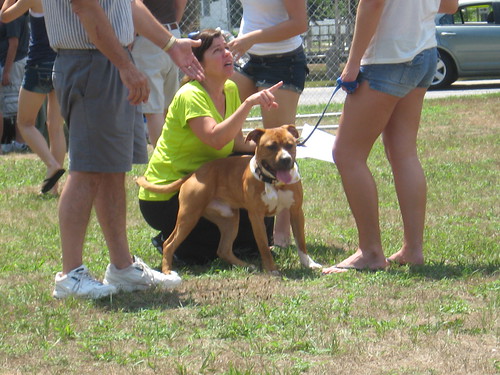
Then we were off to the Pelham Adoption Day. Davey

and Sparky

and Capone

were among the dogs seeking new forever homes.
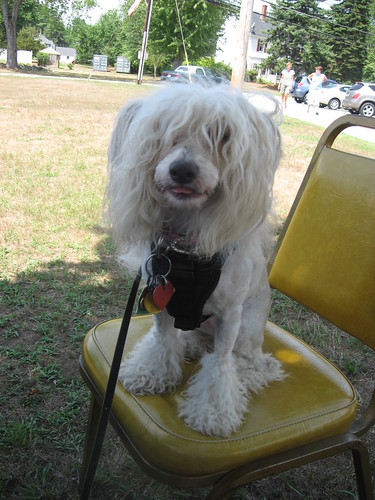
Addy helped staff the table:

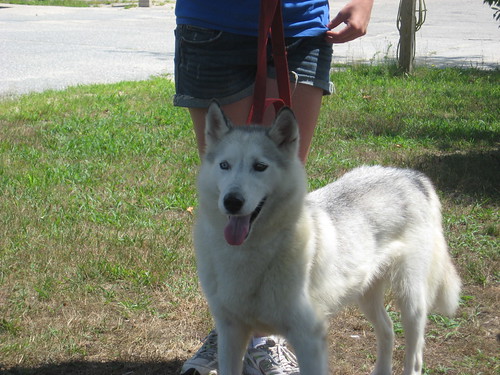
ARNNE also brought this beautiful girl, Gracie:

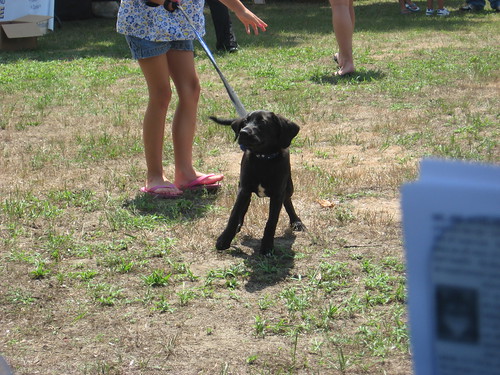
Puppies, too! Although I didn't get this little guy's name:

All in all, it was a lively, fun day, with wonderful, friendly dogs seeking their new forever homes. Don't miss the next one!

Then we were off to the Pelham Adoption Day. Davey

and Sparky

and Capone

were among the dogs seeking new forever homes.
Addy helped staff the table:

ARNNE also brought this beautiful girl, Gracie:

Puppies, too! Although I didn't get this little guy's name:

All in all, it was a lively, fun day, with wonderful, friendly dogs seeking their new forever homes. Don't miss the next one!
Thursday, July 22, 2010
Gucci Needs Your Help
But you can help! Even if you cannot adopt Gucci yourself, you can make a contribution to the cost of his surgery, which will reduce the cost to his adopter--thus speeding the day that Gucci can be adopted and go to the loving forever home he deserves.
Can you help? Even a few dollars will make a difference for Gucci.
See Gucci's Petfinder page for contact information.
Labels:
adoptable,
dogs,
MSPCA,
Nevins Farm,
pets
Pet Oxygen Masks for Derry Fire Department
Every pet owner knows that in the event of fire, our pets are at even greater risk than ourselves--more likely to panic and do the wrong thing, and also generally much smaller and therefore more vulnerable to being overcome by smoke. But while fire departments are well equipped with oxygen masks to help rescue humans, they usually have nothing similar for our pets. Because of this, The Greater Derry Humane Society, the Derry Public Library, and Windham Animal Hospital are raising money to donate pet oxygen masks to the Derry Fire Department. On Wednesday, Windham Animal Hospital and The Greater Derry Humane Society presented oxygen masks to the Derry Fire Department.

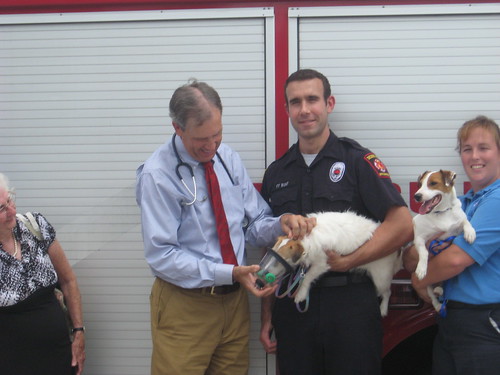
Zoey the Jack Russell Terrier demonstrates the use of the mask with the help of a Derry firefighter and Timothy J. Butterfield, DVM

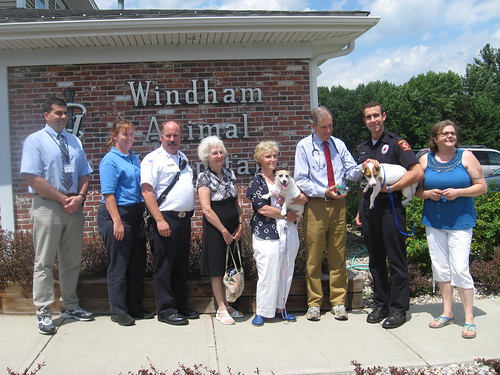
Barbara McCarthy, President of the Greater Derry Humane Society, Timothy J. Butterfield, DVM, Zoey and her brother Niles, and other members of the Greater Derry Humane Society, Windham Animal Hospital, and the Derry Fire Department
Dr. Butterfield did the research to identify the best pet oxygen masks to purchase, and Windham Animal Hospital donated several masks in three different sizes. With the masks being purchased and donated with funds raised by the Derry Public Library and others, pets in Derry will have a much greater chance of being rescued in the event of a fire in their homes.

Zoey the Jack Russell Terrier demonstrates the use of the mask with the help of a Derry firefighter and Timothy J. Butterfield, DVM

Barbara McCarthy, President of the Greater Derry Humane Society, Timothy J. Butterfield, DVM, Zoey and her brother Niles, and other members of the Greater Derry Humane Society, Windham Animal Hospital, and the Derry Fire Department
Dr. Butterfield did the research to identify the best pet oxygen masks to purchase, and Windham Animal Hospital donated several masks in three different sizes. With the masks being purchased and donated with funds raised by the Derry Public Library and others, pets in Derry will have a much greater chance of being rescued in the event of a fire in their homes.
Saturday, July 3, 2010
More Pet Food Recalls--Friday night dump & run recall anouncements
Therese at PetSitUSA caught this announcement of a recall of Merrick Beef Filet Squares Dog Treats for possible salmonella contamination. This is the second time Merrick has recalled these treats for salmonella contamination, although the FDA is annoyed that the first time, Merrick didn't tell consumers about the salmonella contamination.
If you use these treats, please read the announcement and check lot numbers on whatever you have in the house.
Natural Balance has also recalled its Sweet Potato & Chicken Dry Dog Food, also for possible salmonella contamination.
UPG (United Pet Group) has recalled dog nutritional supplements sold under a variety of names. If you use supplements for your dog at all, click the link and make sure your supplements aren't on the (long) list.
And finally (for the moment, as far as I'm aware), Feline's Pride has recalled its Feline's Pride Raw food with ground bone for cats and kittens, Natural Chicken Formula.
For those of us with pets, life has not been the same since the massive, widespread pet food poisonings of 2007. We need to remember that no brand, price level, or quality level of food is immune to problems, and we need to remember that most companies deal with this as a business problem, and try to minimize the damage to themselves, rather than dealing with it as a threat to our pets, and trying to minimize the damage to our pets. And since pet food recalls are not "news" unless they happen on the massive scale of 2007, we need to be alert, and include in our news sources the ones we find to be reliable. The Pet Connection is a great one, as is PetSitUSA. You can check the FDA Recalls, Market Withdrawals, & Safety Alerts site regularly.
And above all, just be aware of how your pet reacts to his or her food. If a pet starts refusing something they've always liked, they may be ill--or there may be something wrong with the food. Never ignore what your pet is telling you!
Hopefully there'll be no more bad news this weekend, and we can all enjoy the Independence Day weekend!
Subscribe to:
Posts (Atom)