Showing posts with label Rabid Puppies. Show all posts

Sunday, August 23, 2015

The Hugo Awards, and Some Thoughts Thereon

Up till now, I've only reviewed the Hugo nominees for this year, and not blogged about the controversy about the nominations. Those who have been following the Hugos this year, though, will be well aware of the Sad Puppies, the Rabid Puppies, and the general fannish reaction to both the fact of the slating, and the perceived poor quality of nearly everything on the slates. (Excluding the Best Dramatic Presentation nominees, both Short and Long Form.)

Last night was this year's Hugo Awards ceremony, and the results are in. The complete Hugo voting results and statistics are available here. Note that this is a PDF. What the detailed results reveal is in some cases heartbreaking. Good work was kept off the ballot. The much-admired Eugie Foster's excellent "When It Ends, He Catches Her," might have made the ballot for Best Short Story without the Puppies' slating, and as she is new deceased, she won't get another chance. Works the Puppies would presumably have loved, including Brad Torgersen's The Chaplain's War and Charles E. Gannon's Trial by Fire, weren't on the slates, and appear to have just missed nomination because of that. [CORRECTION: Gannon's book was on the Sad Puppies slate, while the Rabid Puppies slate dropped it and added Torgersen's book.  It seems likely, therefore, that absent the slating, neither would have made the ballot anyway.] The Puppies didn't even serve their own interests well--at least the Sad Puppies' stated interest of getting overlooked, more politically conservative writers on the Hugo ballot. The Rabid Puppies claim their goal was always to "burn down the Hugos," though that's not what they were claiming at first. The Best Novel winner, The Three-Body Problem by Cixin Liu, made the ballot at all only because Marko Kloos declined his slate-driven nomination for Lines of Departure. The Best Novelette winner, Thomas Olde Heuvelt's "The Day the World Turned Upside Down," likewise made the ballot only because John C. Wright's "Yes, Virginia, There is a Santa Claus" was disqualified due to prior publication.

Tuesday, June 16, 2015

The Stars Came Back, by Rolf Nelson

Castalia House, January 2014

Rolf Nelson is a 2015 nominee for the John W. Campbell Best New Writer Award.

It's a movie script that "morphed into a novel." Except no, it didn't. So it has none of the sights, sounds, and actors that make a move or tv show work, and none of the narrative features that make novels work. Here's the script; you the reader do all the work.

Helton Strom has failed at most things he's tried; the script opens with him managing to crash a flight simulator while doing a crash simulation program. Crashes it in the sense of doing serious damage to it. How? Who knows?

Monday, June 15, 2015

Transhuman and Subhuman: Essays on Science Fiction and Awful Truth, by John C. Wright

Castalia House, May 2014

John C.Wright needs an editor.

With a bit more restraint, his prose could be lyrical--the opposite of the transparent prose the Puppies say they're looking for, and certainly not to everyone's taste, but offering its own kind of enjoyment. Without that restraint, alas, it too often becomes word salad, and at best is tiring and annoying.

Underneath all that excessively ornate prose, what he's saying in this collection of essays is no more attractive. Mr. Wright claims to be a devout Roman Catholic, yet what he is preaching in these essays bears little to no resemblance to anything I was taught in CCD, or have heard preached from the pulpit. He finds science to mostly be a source of spiritual misdirection as it leads us to reject magic and miracles... Sorry, but the priests and nuns who taught me the faith he claims to embrace thought scientific research and the study of science helped to illuminate the glory of God's Creation. That it made the world, in the sense Mr. Wright seems to mean, more magical, not less so.

Saturday, June 13, 2015

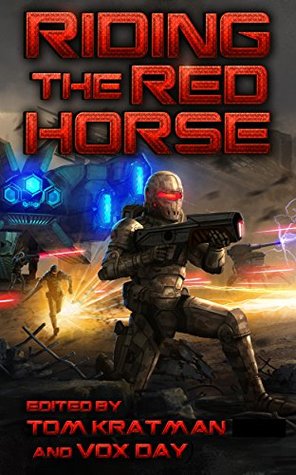
Riding the Red Horse, by Tom Kratman (editor), Vox Day [Theodore Beale] (editor)

Castalia House, December 2014

Theodore Beale (Vox Day) is nominated for Best Editor, Long Form, and also Best Editor, Short Form.

This collection is included in the Hugo Voters packet in support of Theodore Beale's nomination for Best Editor, Short Form.

Unfortunately, it's a very uneven collection. It includes the very good The Hot Equations, by Ken Burnside, and the very disappointing Turncoat by Steve Rzasa. There is, early on, a casual endorsement of the probable "necessity" of genocide on the grounds that Those People aren't smart enough to modify their behavior. A point Beale's fans will have difficulty with is that such inflammatory language makes it less likely that readers will take in the point the author was attempting to make. A better editor would have caught it and told the author to dispense with pointless provocation and just make his point.

If this is the best evidence Beale has to offer, he has no place on the ballot.

Friday, June 12, 2015

The Hot Equations: Thermodynamics and Military SF, by Ken Burnside

Best Related Work Hugo nominee, published in Riding the Red Horse, edited by Tom Kratman and Theodore Beale (Vox Day), December 2014

This is easily the best of the Best Related Works Hugo nominees. Burnside lays out what thermodynamics really mean for military actions and combat in space, at least if you are writing "hard" sf, intended to be based in scientific reality. That's not the only "right" kind of sf to write, but it's great when it's well done--and sad and frustrating when it's done badly. It's one thing to break the rules intentionally; another thing entirely to break them because you don't know you're doing it. As with any other rules, if you're going to break them, you should know you're doing it, and how, and why.

Recommended.